 KR
 US
 AE
 ID
 CN
 TW
 JP
 MN
 RU
 TH
 VN
Understanding the difference as "static" and "dynamic" changes makes it easier to grasp
If you've been looking into treatments for drooping mouth corners, you've probably come across mouth corner Botox and mouth corner filler side by side.
From the names alone, both sound like treatments that lift the mouth corners, but they actually work in different ways.
Mouth corner Botox adjusts the strength of the muscle that pulls the mouth corners downward,
while mouth corner filler complements the volume and shape around the mouth corners.
So rather than asking "which treatment is better," it's important to first look at why your mouth corners appear to droop.
Based on what was explained in today's video, I'll walk through how Botox and filler each work,
and why the two are often done together.
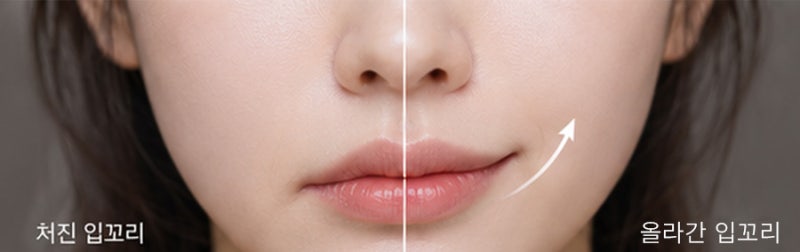
Side-by-side comparison: drooping mouth corners (left) and lifted mouth corners (right).
1. Mouth corners move through a balance between "upward force" and "downward force"
Around the mouth are muscles that act to lift the mouth corners upward,
and, conversely, muscles that pull the mouth corners downward.
At rest, these muscles balance each other to determine the position of the mouth corners and your expression.
However, when the downward pull is relatively stronger,
the mouth corners may appear to droop at rest, or may not seem to lift enough when smiling or speaking.
The key muscle that mouth corner Botox targets is the depressor anguli oris (lip corner depressor).
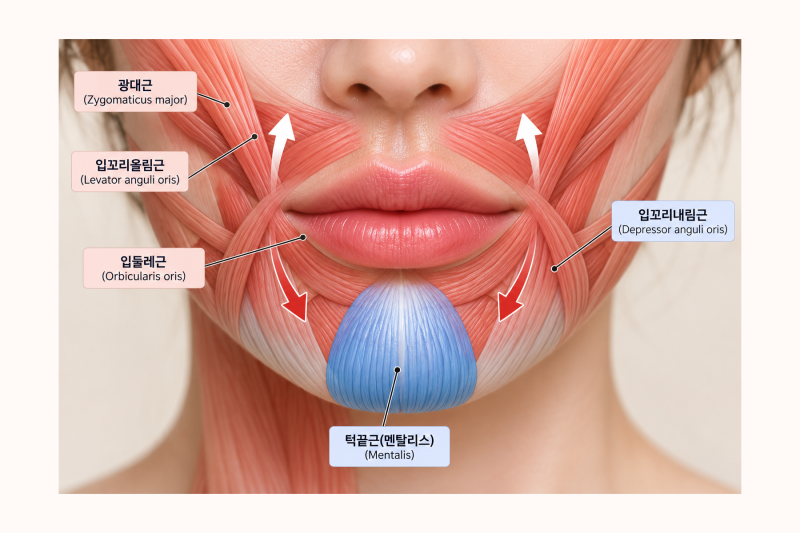
Mouth muscles: zygomaticus major, levator anguli oris, orbicularis oris, depressor anguli oris, mentalis; arrows show lift vs. downward pull.
2. Mouth corner Botox weakens the downward pulling force
Mouth corner Botox uses botulinum toxin injected into the depressor anguli oris, the muscle that pulls the mouth corners downward, to weaken that muscle's strength.
When the downward pulling force decreases, the upward-lifting muscles become relatively more visible.
The video compares this principle to a tug-of-war. (See the link at the bottom.)
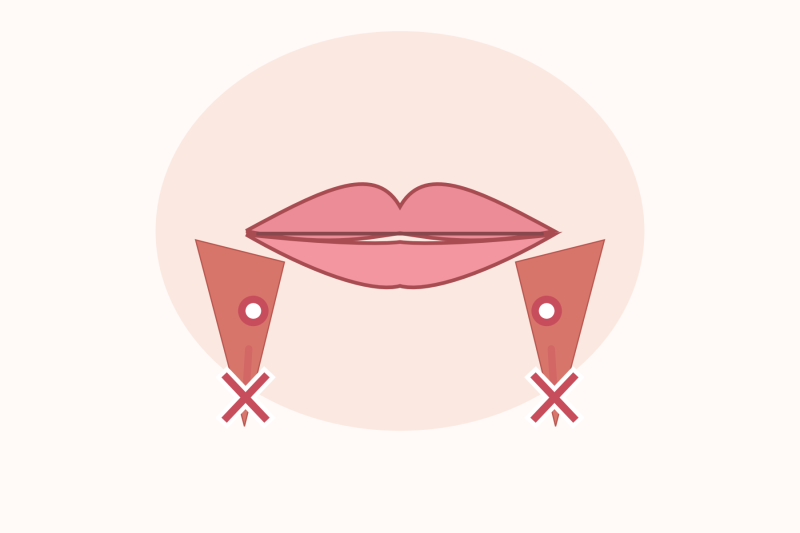
Illustration of the triangular muscles below both mouth corners that pull them down, each marked with a point and an X.
For this reason, mouth corner Botox may produce some visible difference even at rest,
but the change is often most noticeable when the facial muscles are actually moving, such as when smiling or talking, when the mouth corners appear to lift more.
In short, the core of mouth corner Botox can be easily understood as a dynamic change that adjusts movement.
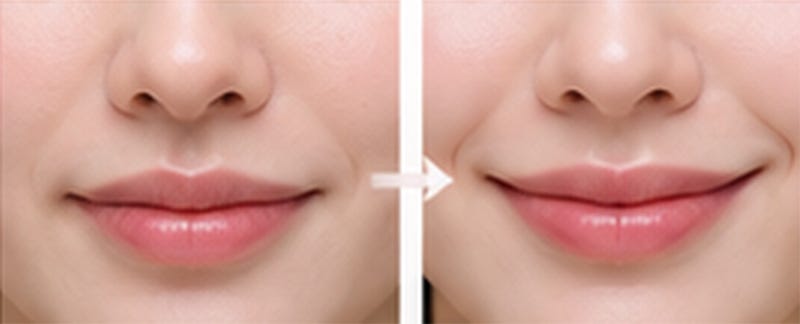
Comparison of lips with downturned corners (left) and upturned corners (right), linked by an arrow.
3. Mouth corner filler changes "shape," not "muscle"
Mouth corner filler is one part of lip filler treatment,
and it adds volume to the tips of the mouth corners or the outer part of the lower lip so the shape of the mouth corners appears slightly lifted.
Rather than weakening muscle strength like Botox does, it's closer to supporting the shape of the mouth corners with filler volume.
So if the mouth corner tips look hollow,
or the mouth corner line appears to fall downward at rest, an approach that complements the shape itself may be needed.
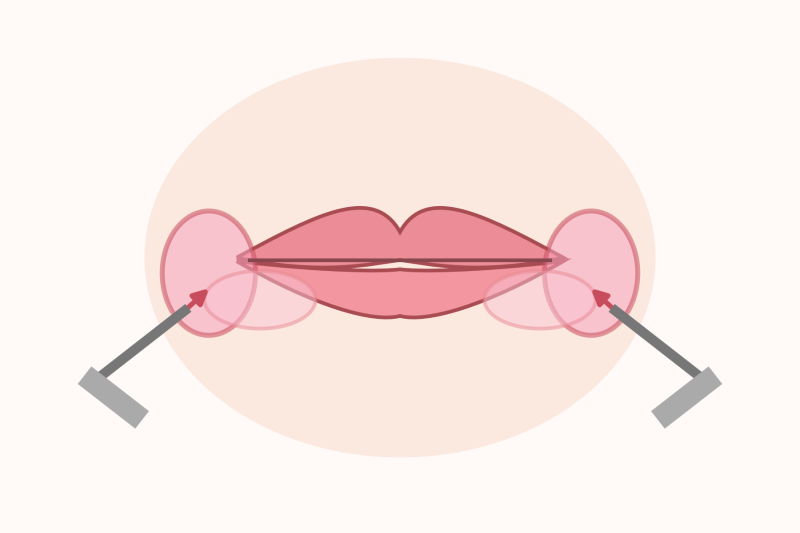
Illustration of injections into both mouth corners, with the injection areas shaded pink.
In summary, mouth corner filler focuses on changing the shape of the mouth corners as they appear at rest.
As the video illustrates,
(See the video at the very bottom)
"When you want to change the shape itself"
is the treatment used in that case.
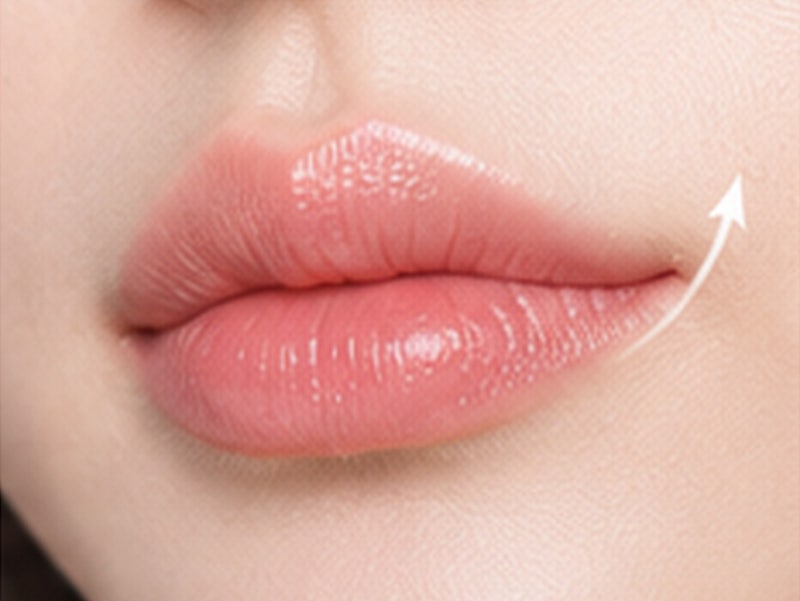
Close-up of lips with an arrow curving upward at the mouth corner.
4. Botox and filler differences at a glance
Category | Mouth Corner Botox | Mouth Corner Filler |
Main focus | Strength of the muscle that pulls the mouth corners down | Volume and shape around the mouth corners |
How it works | Controls and weakens muscle movement | Complements the mouth corner line with volume |
Nature of the change | Dynamic changes when smiling and speaking | Static shape changes at rest |
Other areas to consider | Depressor anguli oris, and mentalis if needed | Mouth corner tips, outer lower lip, etc. |
5. One more muscle to examine: the mentalis
When discussing mouth corner treatments, the depressor anguli oris is not the only muscle to consider.
Another muscle the video explains is the mentalis (chin muscle).
The mentalis is the muscle often mentioned when discussing cobblestone chin Botox or walnut chin Botox.

Illustration of the chin muscle (mentalis) below the lower lip, with arrows pointing upward and diagonally outward.
This muscle is also involved in pulling the mouth corners downward while raising the lower lip.
Therefore, when the mentalis is strong, weakening this muscle as well can also reduce the downward pull on the mouth corners.
6. That's why mouth corner treatments often consider Botox and filler together
The video generally explains that mouth corner treatments involve Botox on the depressor anguli oris and mentalis,
with mouth corner filler added on top of that.
The reason is that their roles don't overlap.
Botox weakens the muscles that pull downward to change dynamic movement,
while filler adds volume and shape to the mouth corner tips to change the static appearance.
Doing both means the mouth corners you see at rest and the mouth corners that move when you smile or talk can each be complemented in different ways.
So which should you look at, Botox or filler?
The first thing to check is
"When do your mouth corners bother you more: at rest, or when making expressions?"
If your mouth corners look fine at rest but feel strongly pulled downward when you smile or talk, muscle movement may be the first thing to look at,
and conversely, if the mouth corner tips look drooped regardless of expression, an approach that complements the shape may be worth considering.
Also, if you tense your chin a lot or your lower lip gets pulled along with movement, the role of the mentalis should be checked as well.
That said, each treatment can have its own effect when done alone.
Ultimately, the key is not to do Botox and filler together by default,
but to determine whether the cause of your mouth corner concern is muscle, shape, or both.
Even a single concern like "drooping mouth corners" can have different causes in reality.
For some people, the strong pull of the muscles that draw the mouth corners down may be the issue,
while for others, the volume and shape of the mouth corner tips may be the bigger problem.
So the core of mouth corner treatment is not simply choosing "Botox or filler," but looking at both the static appearance and dynamic expressions and addressing each needed area separately.
If the difference between mouth corner Botox and filler has been confusing,
remembering that Botox is about movement and filler is about shape, as explained today, will make it much easier to understand.

Please contact Golden Diamant and consider a one-on-one lip consultation with me.
Thank you.
[Video — see original]#LipFiller #LipBotox #LipConcerns #FillerVsBotox #GoldenDiamant #CheongdamPlasticSurgery
Frequently Asked Questions
What is the biggest difference between mouth corner Botox and filler?
Mouth corner Botox can be understood as a treatment that changes movement, while mouth corner filler changes shape. Botox weakens the depressor anguli oris, the muscle that pulls the mouth corners downward, to adjust the changes that occur when you smile or talk. Filler adds volume to the mouth corner tips and the outer lower lip to complement the appearance at rest.
How does mouth corner Botox work?
Mouth corner Botox weakens the strength of the depressor anguli oris, the muscle that pulls the mouth corners downward. When the downward pull decreases, the upward-lifting muscles become relatively more visible, and the lift of the mouth corners when smiling or talking may become more pronounced.
When might mouth corner filler be considered?
Mouth corner filler may be considered when the mouth corner tips or the line of the mouth corners appear to droop at rest. Rather than weakening muscle strength, filler supports the shape with volume added to the mouth corner tips and the outer lower lip.
Why is the mentalis also examined in mouth corner treatments?
The mentalis (chin muscle) is involved in raising the lower lip while pulling the mouth corners downward. So if there is a lot of tension in the chin or the lower lip seems pulled along with movement, the role of the mentalis also needs to be checked.
Do Botox and filler have to be done together?
No, they don't have to be done together. Because their roles don't overlap, they are often considered together, but each treatment can have its own effect when done alone. What matters is determining whether the cause of your mouth corner concern is muscle, shape, or both.
How can I tell whether my mouth corner concern is muscle-related?
It's a good idea to first check whether your mouth corners bother you more at rest or when making expressions. If the mouth corners feel strongly pulled downward when you smile or talk, muscle movement may be the factor. If the mouth corner tips look drooped regardless of expression, an approach that complements the shape can be considered.
